
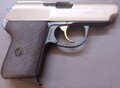
The trigger guard and pin on the P64 is a fairly simple removal. But lets make it complicated and more in-depth. Putting it back together is a little more involved. This was the only part on the P64 that I had not removed before until recently, but I wanted to remove the trigger guard to round off and smooth or melt the very sharp corners as part of my ongoing customizing work on my P64's.
I found that the first time removing the pivot pin was the hardest because there was a lot of residual cosmo in here that I never fully removed in the past. There was still a lot after years of working on these and and shooting them, even after doing the boiling in water trick, hosing down with brake cleaner, then leaving it submerged in kerosene for 24+ hours trick, and even the laying it in an oven on an old cookie sheet on warm for hours on end trick did not ever fully remove. A lot of it actually did come out onto the cookie sheet way back then, but there is always stuff still in there everywhere unless it is actually physically scraped off with a tool after all of the above.
This is true everywhere on the gun I believe -especially causing issues in the high-friction/high-torque areas such as the hammer/trigger pivots and the sear shelves on the hammer and the sear itself. (On those last two you will always, IMHO, get some hair trigger on SA if ALL of this gunk is not TOTALLY removed by hand under magnification so that the sear can fully engage together, but that is a subject for another thread.)
- Clamp
You don't need a ton of pressure on the clamp, too much and you can damage the slide or the slide rails here! It also wants to jump off if not put on just right. The clamp is merely to hold the trigger guard up in the slightly compressed position while you work to push (not drive) out the pin. Finger tightz so to speak. You should not need anything more than a paper clip here to push out the pin if everything is aligned. If you do use a punch don't use anything to push the punch but your own soft fingers. No hammers. It should come out fairly easily even if sort of glued in by cosmo gunk. Wiggle the trigger guard until the pin is aligned and the load on the pin will just disappear and you can feel it wiggle once it isn't under any load. It should just drop out when poked through.
I am puzzled why the Polish designers fumbled the ball on the trigger guard spring plunger design so badly. The plunger pin diameter is too small to fit the spring properly and does not extend far enough into the spring to align the plunger to the spring until the plunger is partially engaged into the recess and the whole assembly is already under a pretty decent spring load. This makes an already difficult assembly much harder than it needs to be compared to the PPK.
The PPK does not have this issue since the plunger has more material inside the spring to align it than on the other side. On the P64 the plunger only goes in easier once the plunger itself is riding inside the recess to keep it aligned but it takes a significant amount of spring compression to get to this point. Up until that point the plunger wants to kick to the side and jam. It's a two-thumb job to compress the trigger guard up against the frame and keep it aligned which leaves zero hands left for aligning the plunger into the hole. You've gotta push it all in while guiding everything just right which makes the job 10x harder than it needs to be. There is a similar issue with the safety plunger if the spring is too long but at least that fits tightly on its own (light) spring unlike the trigger guard spring.
- Crooked
- Straight but sloppy
I think perhaps that the Polish armorers must have had some sort of jig they used to hold the pieces in perfect alignment and then cranked the trigger guard up into place against the frame. One wouldn't be too hard to make out of plywood and cutting out the shape with a jigsaw for the pistol and a screw clamp to just push the pieces together easily in place with just enough force to compress the spring. Without such a jig it is a 2 person job, or use a temporary pin that you can hold in your mouth while you compress and align with both hands. Then use a hand clamp like I showed for fine-alignment.
I did do it finally without the clamp by dropping the pin into place with the spring partially compressed with one shaking thumb and after that pushing with both thumbs all the while aligning the holes blind just by feel with the pin halfway in blocking my view. It works but it takes quite a few practice tries and you need a LOT of thumb strength and also a LOT of control and feel at the same time for it to just fall in. Dont let it fall through to the other side! A piece of blue painters tape on the bottom side helps here but hurts your ability to get light in there while doing the first step. Pick your poison.
All this because the Poles didn't just use the design from the Germans on the PPK and instead "improved" it here on this simple part. Cholera jasna!
Also, the plunger seems to be too pointy where it contacts the trigger guard and on the one I disassembled as well as all the parts kits I accumulated over the year the pointy end seems to have been worn funny and even peened over where it contacts and rubs on the trigger guard over time. I have cleaned that up a bit and flattened the tip a little so that it is more dome-shaped than a sharp point. I think a very pointed tip is the wrong shape here just like the safety detent plunger is too pointy for smooth operation and can use a little dome-shaping itself.
I have chucked up these safety detent pins in my drill and run them carefully into a little 600-grit sandpaper to machine a more dome shape and less pointy one. And then eventually going to 1000 and 2000-grit after testing that they still work. Don't take too much off at a time (but that is for another thread too)
That is exactly what I did to the plunger for the trigger guard plunger and it seems to work much better now. I took very little material off and kept the shape very close so the trigger guard can pivot without binding or wearing on the pivot. The metal used on this part does not take cold blue well unlike most other parts on this gun.
The trigger guard also had this cold blue problem after I "melted" the razor sharp edges and polished the many porous flaws out of the surface. Same for the trigger itself. Why they made these edges so darn sharp is beyond me. This trigger guard is eventually going out to be refinished Nitride Carbide Black ALTiN by Brazen eventually but in the photo you can see the poor job of cold blue. This particular trigger has not been melted yet but have one at Brazen right now getting Gold TiN titanium nitride for my next build along with a hammer strut and trigger bar for reduced friction and wear properties. But that too is another thread.